How to Read Bill Gates on AI as a Warning Rather Than a Forecast
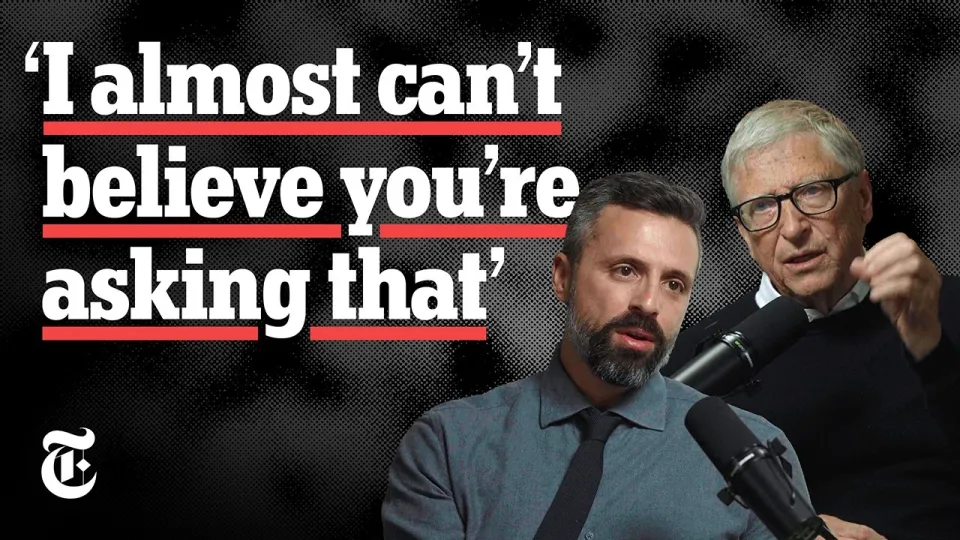
Video: Bill Gates: A.I. ‘Makes Nuclear Weapons Look Like Nothing’ | The Ezra Klein Show
Need articles like this for your video? They help promote it on YouTube and Google — order them in the Telegram bot @sat_sit_bot. The bot writes and publishes the articles itself (with your YouTube video embedded) on popular topical websites (no ads). Your first 50 articles are free.
· based on the channel The Ezra Klein Show
AI is best understood, in Bill Gates's telling, not as a product cycle but as a governance emergency: he argues that artificial intelligence could produce catastrophic cyberattacks, bio-terrorism and mass job loss, that industry self-regulation is "insane," and that the technology makes nuclear weapons "look like nothing." The fullest version of that argument is his conversation with Ezra Klein on The Ezra Klein Show, published on September 29, 2026, and the full transcript and episode page is the place to check his exact wording rather than a paraphrase.
What Gates actually claims about AI risk
Gates's position is a reversal, not a restatement. For years he was among the prominent technologists who treated dire AI warnings as premature; in this conversation he says the alarmism has not gone far enough, and he separates the risk into concrete thresholds rather than a single vague doomsday. The two he names most directly are cyber and bio: AI that meaningfully lowers the barrier to writing damaging code or to engineering pathogens. That framing matters because it converts an abstract debate into a regulatory question — at what capability level does a model stop being a tool and start being a weapon, and who is allowed to decide.
He is equally direct about the people in charge. Klein's own summary of the episode is that Gates seemed genuinely afraid we are not ready for what is being built, and emphatic that many people in positions of authority are in denial about it. That is a claim about institutions, not just about software.
Why self-regulation fails in his account
Gates's core institutional argument is that voluntary safety commitments cannot survive competitive pressure. If one lab slows down and another does not, the slower lab loses the race and the faster one sets the norms; a promise that is rational for one company in isolation becomes irrational for it the moment a rival ignores it. He calls the idea that the AI industry can simply police itself "insane," and the sharpest illustration in the episode is his reaction to the notion that harm would be handled through litigation after the fact — the point being that lawsuits are a remedy for damages already done, not a barrier in front of a catastrophe.
This is where his comparison to nuclear weapons does real work. Nuclear arms are governed by treaties, inspections and state authority precisely because markets were never expected to manage them. Gates is arguing that AI belongs in the second category, and that the current arrangement — a handful of labs, a handful of voluntary frameworks, and regulators who arrive after deployment — is the first category wearing the second category's clothes.
The China variable and the race-versus-safety trade-off
Any serious safety regime has to answer the question of what happens when a competitor does not join it. Gates treats the AI race with China as the central obstacle to unilateral restraint: a country that slows down while a rival accelerates hands the advantage away, so safety commitments that are voluntary and national are structurally fragile. The implication is not that regulation is impossible but that it has to be coordinated and reciprocal — the same logic that produced arms control rather than unilateral disarmament.
That is also the strongest counterargument to his own position, and it is worth stating plainly. If coordination is the precondition, and coordination is slow, then the practical choice is between imperfect rules now and no rules later. Gates lands on the first, which is why he keeps returning to government rather than to company pledges.
Jobs, inequality and the case for taxing AI labor
Gates extends the argument from safety to distribution. He warns of mass job loss and describes a future job market with less scarcity, where the question shifts from whether work exists to who captures the productivity gains. His proposed instruments are unusually concrete for a technologist: taxing AI labor as a way to fund the transition, and designating certain roles as "human reserved" — work that stays with people by rule rather than by market accident.
He also ties this to the Gates Foundation, which is set to spend down around $200 billion over the next two decades, and which he has said will treat making AI a force for equality, rather than an engine of inequality, as a new priority. The global dimension is the part most often missed in rich-country debates: if the productivity gains of AI accrue mainly to countries that already own the compute and the models, the gap widens fastest where institutions are weakest. His line about inequity being permitted to exist because of distance is the version of this that stays with listeners.
Education, children and the regulation gap
Education is where Gates is most optimistic and most specific. He sees genuine potential in AI tutoring and in language tools that can extend quality instruction to students who would never otherwise get it, and he connects that to learning loss in rich countries — the gap that opened during the pandemic and has not closed. The same tools, though, create an obvious problem for children, and he argues for regulation aimed specifically at minors rather than treating them as ordinary users with ordinary consent.
The questions listeners keep raising
The recurring doubts are worth taking seriously rather than dismissing. Three come up again and again.
- Is Gates credible on this, given his own history? He is a technologist who spent decades arguing that the benefits of computing would outweigh the disruption, and he now says the disruption may outrun the benefits. That is either a conversion or a late correction; either way, the argument has to stand on the thresholds he names, not on his biography.
- Isn't this just alarmism from someone who no longer runs a lab? The counter is that his claims are falsifiable — cyber capability, bio capability, employment data — and he is asking for specific instruments, not a mood.
- Won't regulation simply hand the advantage to rivals? This is the strongest objection, and Gates's own answer concedes it: coordination is required, which means the debate is about how to build it, not whether restraint is costless.
One observation from the audience reaction is more useful than it first appears: Gates does not interrupt to shoot down a question he disagrees with, he waits and answers it. That style is why the disagreement with Klein reads as substantive rather than performative — and why the episode is a better guide to his position than any summary, including this one.
Useful links
- The Ezra Klein Show episode page and full transcript
- Book recommendations from guests of The Ezra Klein Show
Bottom line
Gates's argument is narrower and more actionable than the headline quote suggests: AI is a governance problem with identifiable thresholds, voluntary self-regulation cannot hold under competitive pressure, and the transition needs fiscal tools such as taxing AI labor and reserving some roles for people. The China race is the honest obstacle to all of it, and he does not pretend otherwise. Read the transcript of the conversation before quoting him, because the specifics carry the weight. The episode was produced by The Ezra Klein Show, and it remains the most direct statement of his current position.
Key takeaways
- Gates calls the idea that the AI industry can self-regulate "insane" and wants government action on cyber and bio thresholds.
- He ranks AI as more dangerous than nuclear weapons, warning of catastrophic cyberattacks, bio-terrorism and mass job loss.
- The Gates Foundation plans to spend down roughly $200 billion over two decades, with AI-driven inequality as a new priority.
- He frames the AI race with China as a reason safety work cannot be unilateral or voluntary.
- His proposals include taxing AI labor, "human reserved" jobs and regulation protecting children online.
Source: Bill Gates: A.I. ‘Makes Nuclear Weapons Look Like Nothing’ | The Ezra Klein Show · Markdown version
Questions & answers
Why does Bill Gates say AI makes nuclear weapons look like nothing?
He is ranking consequences rather than destructive power. Nuclear weapons are bounded by the number of warheads and by state control, while AI lowers the cost of capability — code, pathogens, persuasion — for many actors at once. His argument is that a technology that distributes leverage that widely is harder to contain than one that sits in silos.
What does Gates propose instead of industry self-regulation?
Government rules tied to capability thresholds, especially in cyber and bio, plus coordination between countries so that no single lab or nation gains by defecting. He dismisses the idea that harm would be handled through lawsuits after the fact, since litigation arrives after the damage.
Does he think AI will destroy jobs entirely?
He describes a job market with less scarcity and warns of mass job loss during the transition, not permanent mass unemployment. His proposals — taxing AI labor and marking certain roles as human reserved — are aimed at who captures the gains, not at stopping the technology.
What is the strongest objection to his position?
That unilateral regulation hands the advantage to competitors, particularly China. Gates largely concedes the point, which is why his answer is coordinated and reciprocal rules rather than one country slowing down alone.